
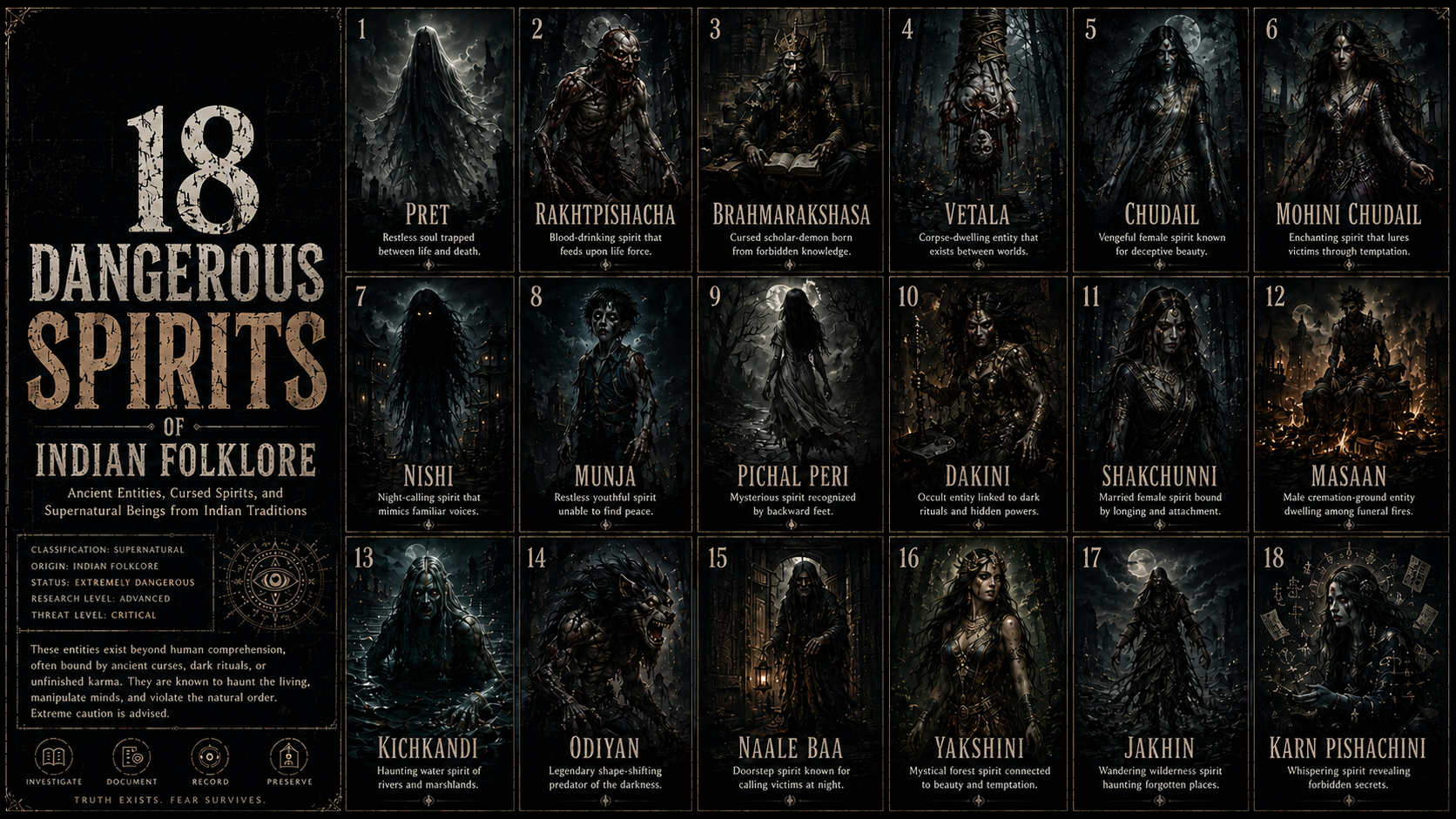
Across the regional folklores of the Indian subcontinent, certain entities are not described as ghosts in the casual sense — they are catalogued as predators, parasites, or guardians with very specific operational rules. In the field telemetry logs of Indian Paranormal Society, veteran investigator Ram Ashok Kumar treats each of them less like a campfire story and more like a documented anomaly with a territory, a feeding pattern, and a way to be contained.
Below are eighteen of the most consistently feared spirits in Indian tradition — their origins, the environments they occupy, and the mechanisms that make them dangerous.
1. Pishacha (The Parasitic Frequency of Madness)
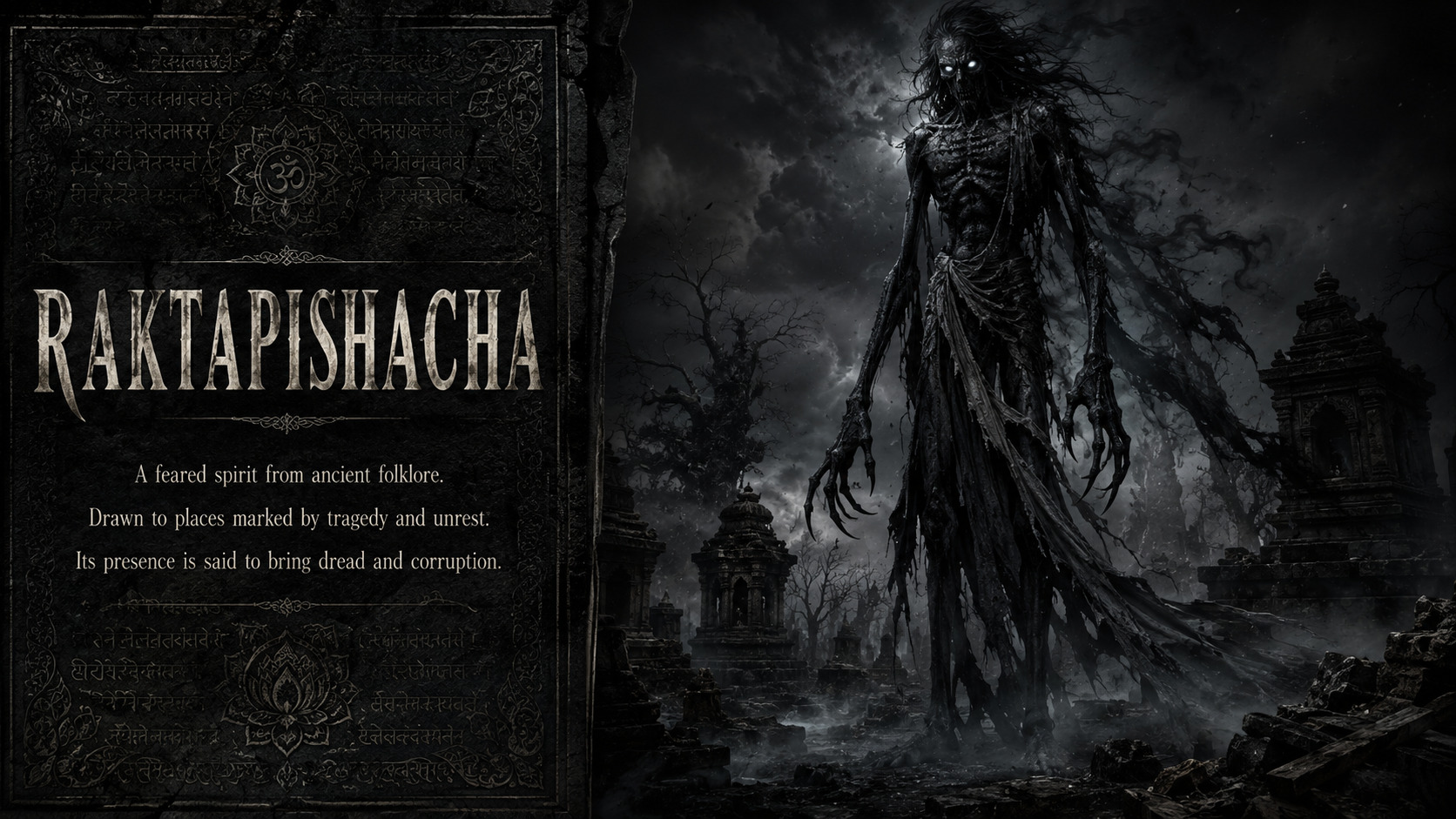
In the field telemetry logs of Indian Paranormal Society, the Pishacha is classified not as a localized ghost, but as a predatory, low-frequency energetic parasite. Originating deep within ancient North Indian folklore and occult texts, these entities are born from raw malice, violent deaths, or massive moral corruption. While mainstream tales depict them as physical monsters feeding on flesh, veteran investigator Ram Ashok Kumar maps their true predatory blueprint as psychological and energetic consumption. They feed aggressively on Prana (vital life force) and the dense, volatile emissions of human fear, grief, and insanity.
A Pishacha typically materializes in environments heavy with decay — abandoned ruins, unblessed grounds, and isolated fields during Amavasya (the night of the new moon). The mechanism of their attack targets the human mind's weakest defensive vulnerabilities. When a person walks alone under a designated tree or crosses an active spiritual boundary at midnight, a Pishacha breaches their auric field. It injects a heavy spiritual static that completely scrambles Western hardware diagnostics; EMF meters and digital thermal cameras short-circuit or display severe signal pixelation in their presence.
Once attached, the entity slowly warps the host's cognitive architecture. The victim shifts into severe states of paranoia, visual hallucinations, and a sudden, uncharacteristic craving for raw, decaying food. To break a Pishacha's hold, typical ghost-hunting tactics fail completely. It requires rigorous, boots-on-the-ground Tantric binding protocols, using precise sonic frequencies and protective geometric layouts to slice the entity's tether away from the physical target and purge the dark frequency from their subconscious mind.
2. Brahmarakshasa (The Fallen Mind of Intellect)
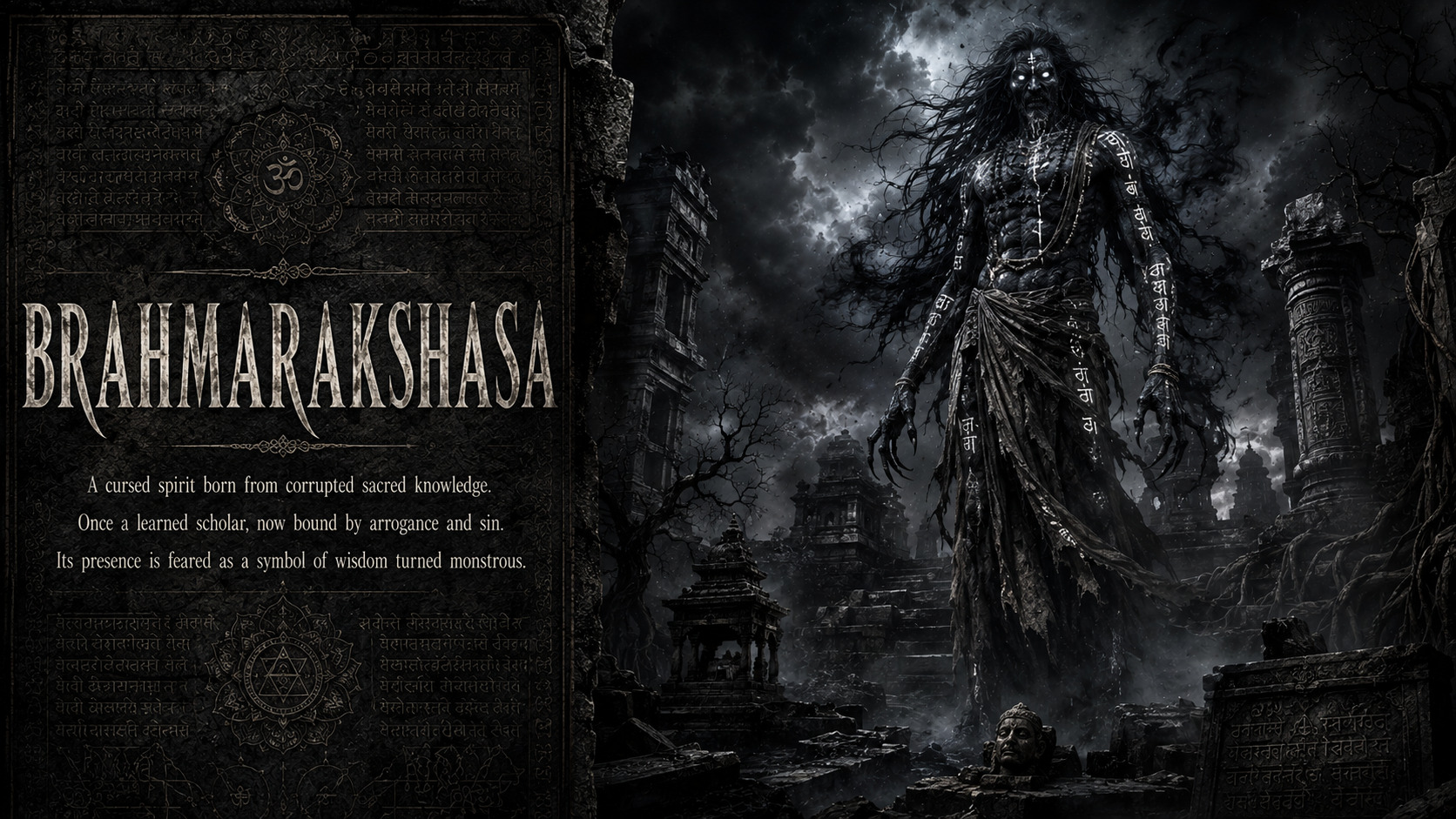
The Brahmarakshasa stands as one of the most terrifyingly complex and intellectually formidable anomalies documented in the archives of Indian Paranormal Society. This entity represents the ultimate subversion of high spiritual knowledge. It is born when a highly educated scholar, priest, or Brahmin misuses their sacred power, practices dark arts for malicious gain, or dies with an overwhelming burden of unatoned ego and sin. The resulting transition forces their vast repository of intellectual merit to curdle, warping them into a demonic spirit of immense power and malevolent authority.
A Brahmarakshasa operates on a massive geopolitical and environmental scale. While standard human remnants haunt a room or an object, a single Brahmarakshasa can hijack and control the environmental energy grid of an entire ancient temple complex, historical fort, or massive sacred tree hollow. They possess a terrifying hierarchy, frequently commanding lower-order entities like Bhutas and Pretas to act as frontline guards for their territory. Physically and ethereally, they manifest as towering, intimidating silhouettes, often mocked by the tattered shreds of sacred threads clinging to their energetic signatures.
Confronting a Brahmarakshasa presents an extreme risk to investigators. They do not lash out blindly with animalistic fury; instead, they exploit the precise ritual mistakes or hidden moral hypocrisies of those trying to banish them. They are fully capable of mocking sacred chants or weaponizing an investigator's hidden trauma against them. Ram Ashok Kumar emphasizes that navigating a Brahmarakshasa zone demands absolute spiritual discipline and the invocation of fierce, higher cosmic enforcers to shatter the deep-seated karmic curse binding the entity to the earthbound realm.
3. Vetala (The Corpse-Dwelling Automaton)
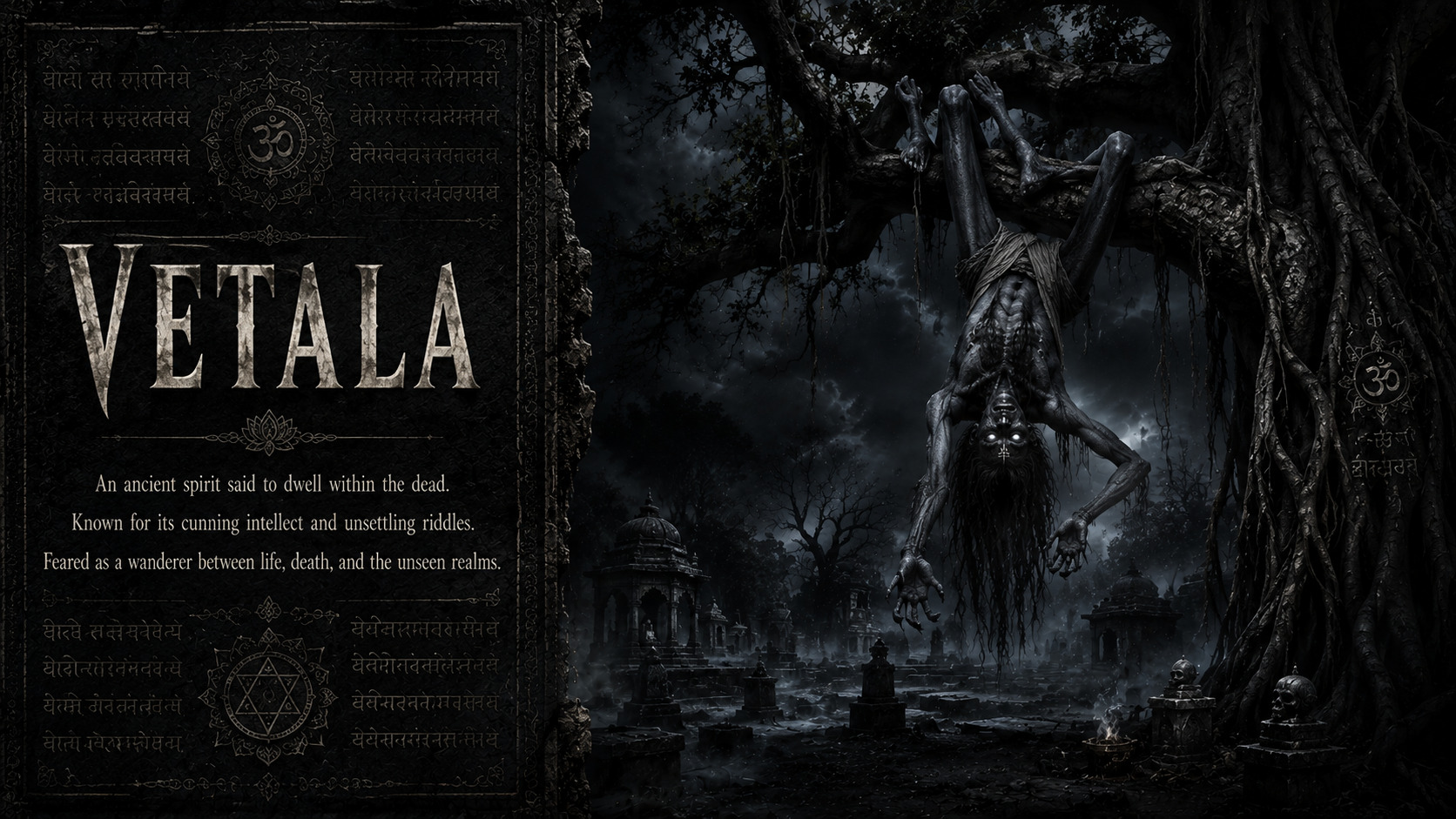
The Vetala represents a unique and disturbing mechanism within metaphysical research: a powerful, non-human entity that functions as a spiritual parasite requiring a physical vehicle to operate in our reality. Rather than existing as an ethereal, transparent apparition, the Vetala actively occupies and reanimates human corpses. It treats dead flesh as a mechanical puppet, turning a decaying vessel into a highly agile, extraordinarily dangerous automaton capable of moving with terrifying speed and unnatural strength.
Vetalas are fundamentally rooted in active cremation grounds (Shamshans) and forgotten, deep forest burial zones. The structural signature of a Vetala injection into a body is a complete halt or dramatic deceleration of biological decay, replaced instead by an intense, cold biological static. A reanimated corpse under Vetala control can scale vertical walls backward, survive devastating physical impact, and see perfectly in total darkness. More dangerously, they retain access to the dead brain's memory bank, utilizing the personal history and vocal cords of the deceased to speak in complex riddles, mock survivors, and play devastating psychological games with intruders.
Astrologically, Vetalas are hyper-sensitive to universal cycles, reaching their peak operational capacity during Amavasya. Because their presence is heavily anchored into a physical vehicle, traditional Western banishments and standard digital equipment offer zero defense. Neutralizing a Vetala anomaly requires advanced Tantric mastery — specifically the usage of consecrated ritual irons and grounding mudras to forcefully break the entity's injection lines, severing its connection to the physical vehicle and rendering the host body permanently inert.
4. Churel / Chudail (The Vengeful Lineage Matrix)
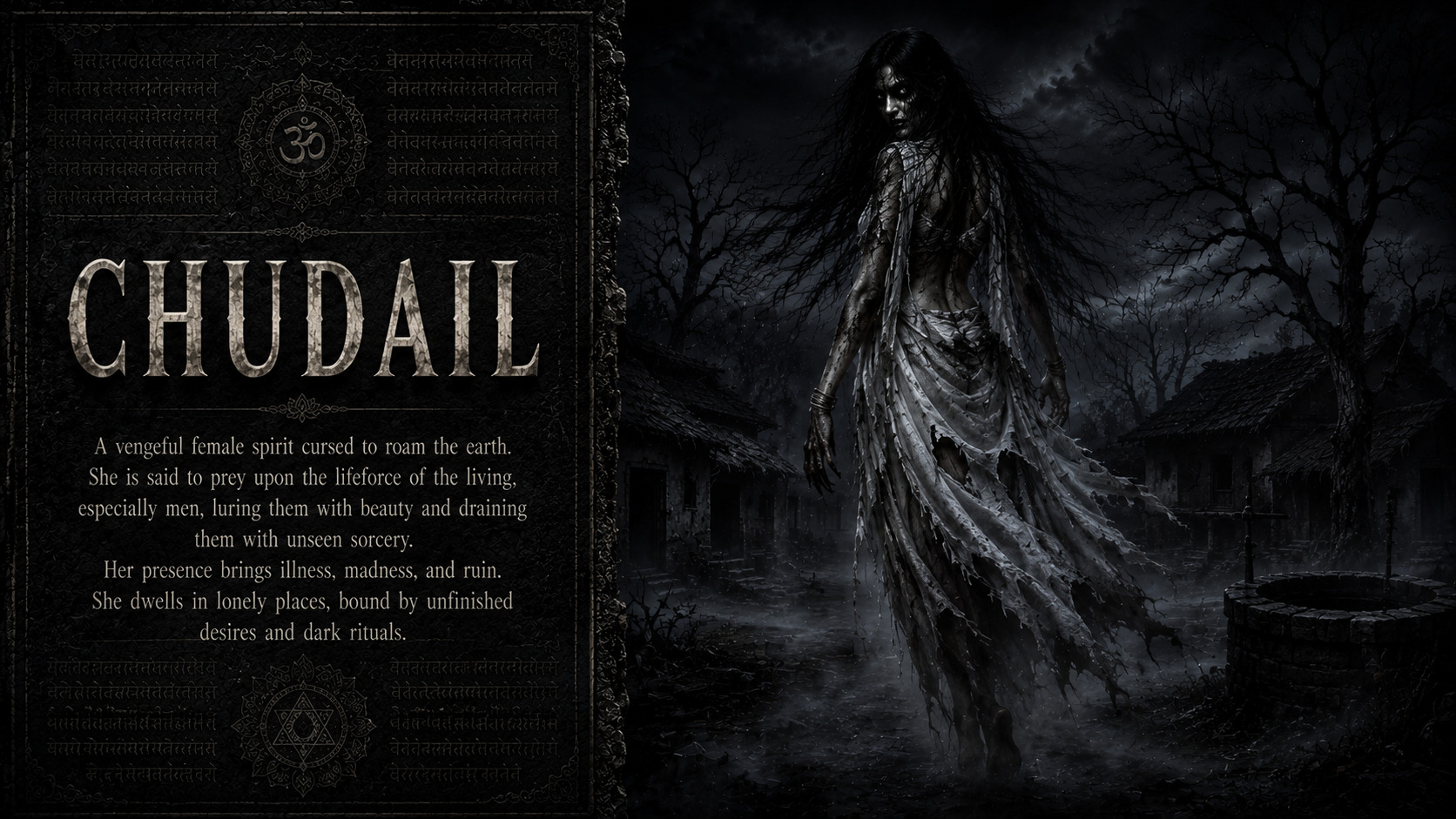
The Churel (or Chudail) is arguably the most widespread and deeply feared female supernatural anomaly across the Indian subcontinent. Far from a generic campfire legend, the mechanism behind a Churel manifestation is rooted in intense societal and physiological trauma. This spirit is born when a woman dies during pregnancy, childbirth, or due to severe, systemic abuse by her marital family. The sudden, violent severance of life at a moment of maximum vital vulnerability and unfulfilled maternal instincts generates an explosion of dense, earthbound negative energy.
The signature hallmark of a Churel — well-documented in historical lore and private case files — is her backward-facing feet. Ethereally, this structural deformity represents her permanent rejection of the natural evolutionary path, keeping her anchored in a state of eternal, vengeful regression. She typically haunts the outer peripheries of villages, abandoned highway stretches, and the dark canopies of isolated trees. She shifts her appearance with extreme fluidity, projecting hyper-realistic illusions of a breathtakingly beautiful woman to lure young men traveling alone at late hours.
Once a target steps into her energetic field, the illusion collapses, exposing a gaunt, terrifying entity with elongated limbs and unkempt hair. A Churel does not just kill her victims; she feeds systematically on their virility and life force, leaving behind a completely dried, hollowed-out corpse within a matter of hours. Ram Ashok Kumar's investigations reveal that a Churel anomaly is frequently tied to a specific family lineage or location where the original injustice occurred, requiring deep ancestral healing, karmic justice, and intense cleansing rituals to safely untether and ground the entity's agonizing rage.
5. Nishi (The Auditory Siren of Bengal)
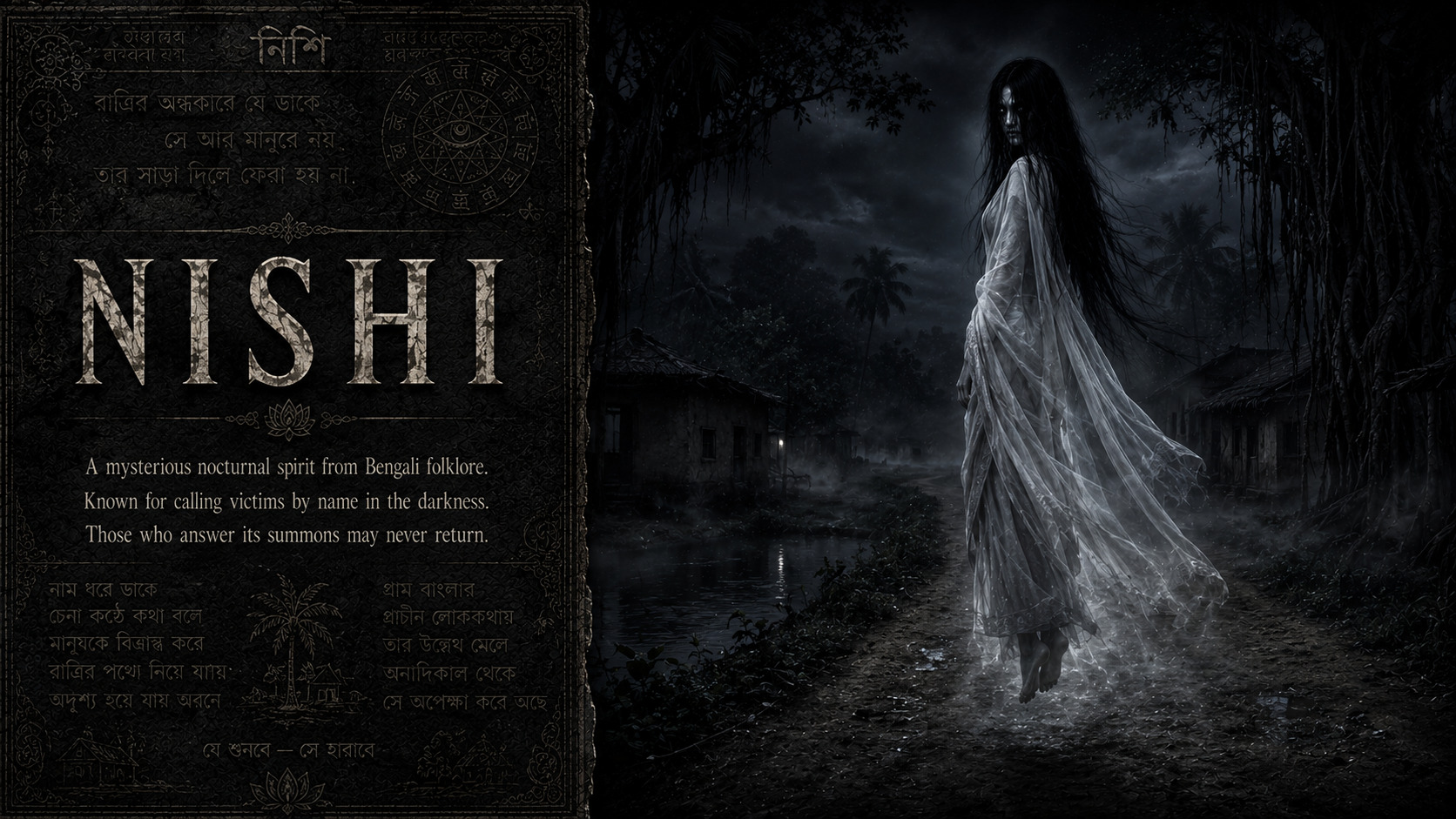
The Nishi stands as one of the most insidious and psychologically devastating entities found in the supernatural lore of Bengal and Eastern India. Often referred to as the night-caller, the Nishi operates almost entirely through auditory deception and psychological manipulation. Unlike entities that breach an environment with sudden physical crashes or dramatic thermal drops, the Nishi slips quietly into a target's consciousness, weaponizing their personal attachments and memories to lure them to their doom.
The operational mechanism of a Nishi is precise and absolute. It waits until the dead of night, typically after midnight when the human nervous system is resting and vulnerable. It stands outside the target's house or at the edge of a deep forest and calls out the victim's name. What makes the Nishi deadly is its voice — it perfectly mimics the exact tone, inflection, and cadence of someone the victim deeply loves and trusts, such as a mother, a spouse, or a close friend. According to folklore and field research, the Nishi will only call out a name exactly two times. If the victim answers or opens their door to follow the voice, they fall into an immediate, hypnotic trance.
The victim walks blindly into the dark, guided only by the fading echo of the familiar voice, leading them into deep swamps, deep wells, or dangerous cliff edges where they meet a fatal end. Those rare individuals who survive a Nishi call are often left completely mute or permanently insane. Within the analytical framework of Indian Paranormal Society, the Nishi is understood as a specialized acoustic predator that targets the human emotional spectrum, proving that traditional elders' warnings — never to answer a voice in the dark until it has called out at least three or four times — are vital boundaries designed to protect the mind from fatal psychological ingestion.
6. Mohini Chudail (The Glamour of Lethal Entrapment)
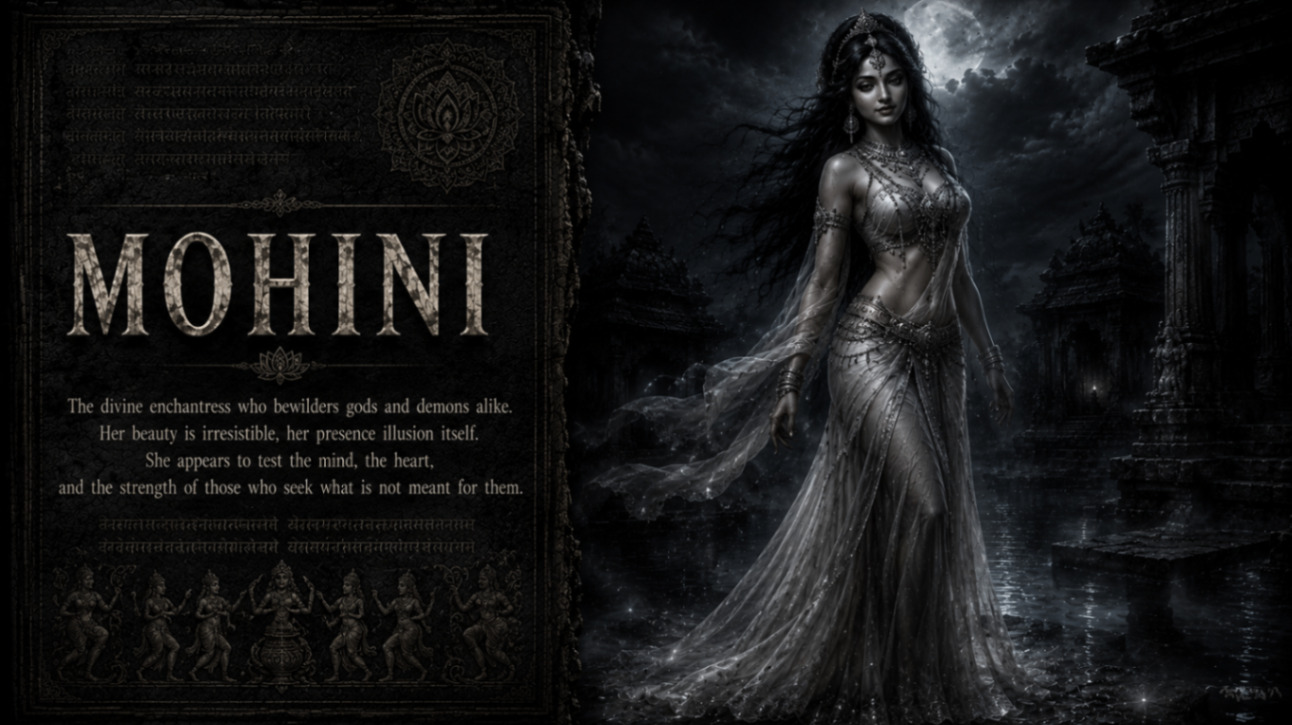
The Mohini Chudail is a highly specialized and dangerous subset of the female spirit hierarchy, operating on the principle of extreme sensory glamour and emotional manipulation. While a standard Churel is born of maternal and marital trauma, a Mohini is created when a young woman passes away with massive, unfulfilled romantic desires, raw obsession, or after being brutally betrayed by a lover. The resulting entity becomes the literal manifestation of lethal enchantment, using Kama (erotic and aesthetic energy) to hunt down and consume her victims.
A Mohini typically materializes near old stone structures, fragrant flowering bushes, or isolated rural crossroads under the cover of night. She projects an all-enveloping aura of overwhelming beauty and intoxicating floral fragrances (often resembling jasmine or wet earth) that immediately overpowers a target's sensory equilibrium. She specifically hunts young men, appearing to them as a solitary, ethereal woman in need of companionship. The mechanism of her attraction works like a drug; the target undergoes a severe spike in dopamine and a total collapse of survival instincts, leaving them entirely blind to the underlying danger.
Once the victim is thoroughly ensnared within her energetic grid, the Mohini begins to rapidly siphon their Ojas (spiritual and physical vitality). The target experiences a profound detachment from reality, wasting away in a state of permanent daydreams, unable to eat, sleep, or communicate with the living. In his 25 years of boots-on-the-ground field experience, Ram Ashok Kumar has noted that Mohini attachments are incredibly difficult to diagnose early on, as the victim actively protects the entity. Eradicating a Mohini current requires aggressive Tantric intervention to forcefully tear down the illusionary matrix and snap the victim's nervous system out of the entity's parasitic loop.
7. Munja (The Volatile Biological Static)
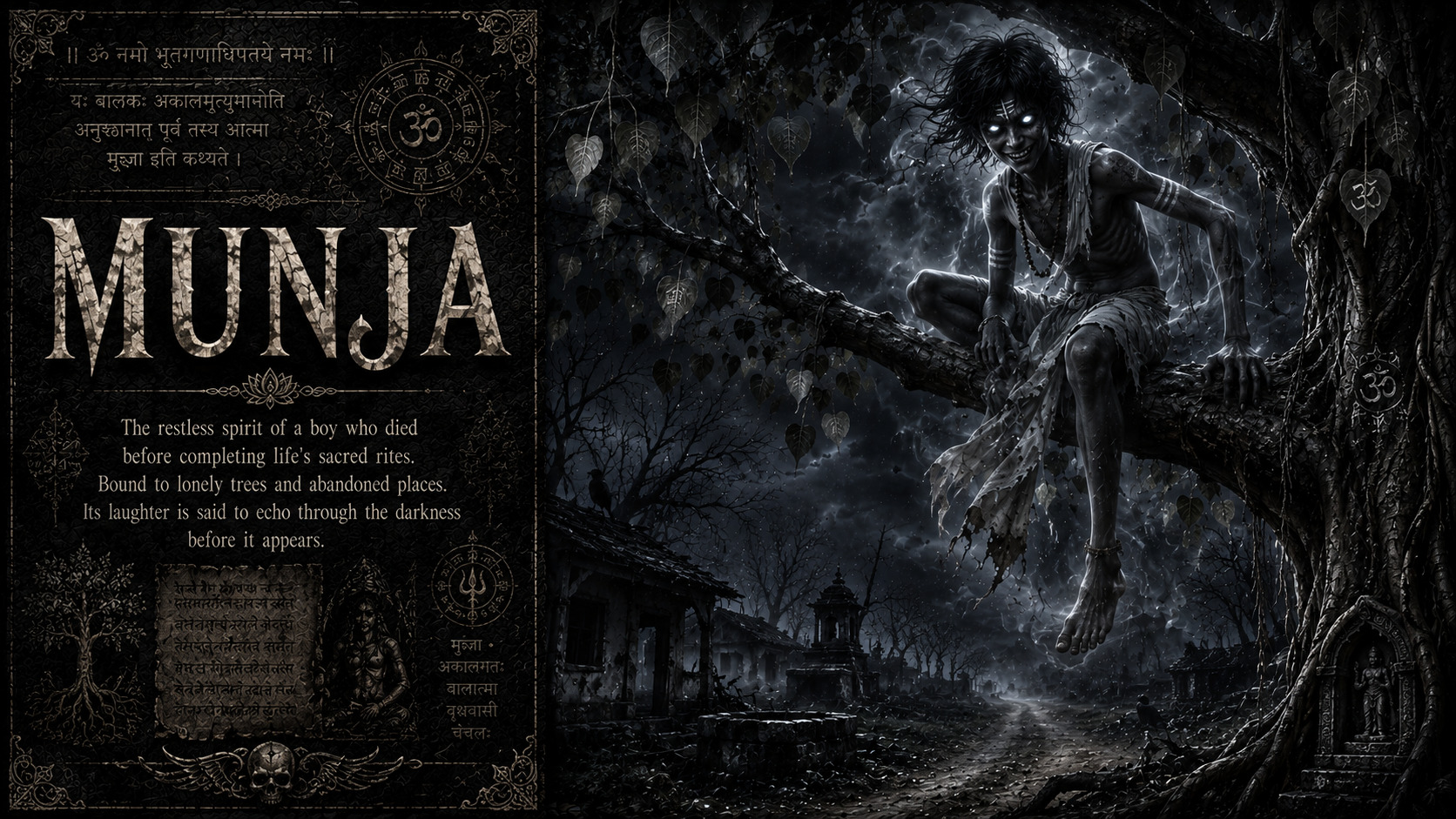
The Munja (or Munjya) is a uniquely aggressive and hyperactive entity born from a very specific cultural and spiritual transition. In traditional Indian customs, a young Brahmin boy undergoes the Upanayana (sacred thread ceremony). If the boy dies after his thread ceremony but before his marriage — specifically during his student phase of life (Brahmacharya) — his consciousness becomes trapped in an intense, unfulfilled liminal state. The resulting spirit is a Munja: a highly volatile, mischievous, and occasionally lethal vortex of raw, adolescent energy.
Munjas are notoriously tied to the botanical landscape, almost exclusively inhabiting old, massive Peepal (Ficus religiosa) trees, Banyan trees, or wells near deserted historical structures. The mechanism of a Munja's presence is characterized by an intense, erratic biological static. When modern paranormal investigators set up digital equipment near a Munja-haunted Peepal tree, their camera sensors consistently experience pixelation, sudden battery drainage, and erratic EMF spikes. This isn't generic equipment failure; it is the physical manifestation of a restless, hyper-kinetic energy grid disrupting the electromagnetic spectrum.
A Munja is fiercely protective of his designated tree. If a human intruder disrespects the space — such as by urinating near the roots, casting stones into the branches, or resting under the canopy at exactly noon or midnight — the Munja retaliates instantly. He can manifest sudden physical violence, throwing heavy stones from empty branches, or cause the intruder to develop a sudden, blazing fever and severe abdominal pain. In advanced Tantra science, resolving a Munja anomaly requires specific pacification offerings, sacred strings, and ritual relocation to ground the hyperactive teenage consciousness into a state of permanent spiritual rest.
8. Pichal Peri (The Backward Sentinels of the Outer Rims)
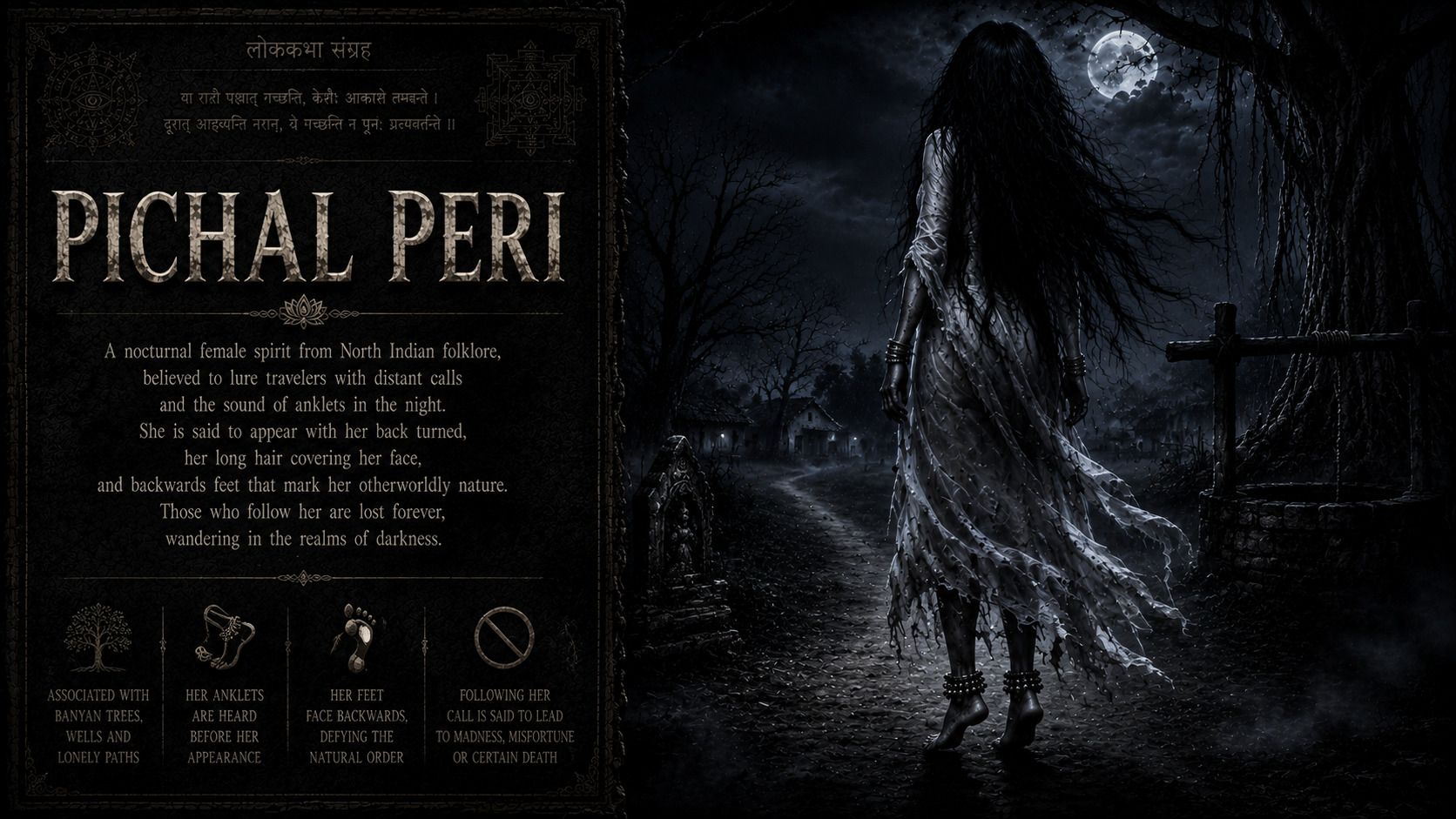
Deeply feared across the rugged mountain terrains of Northern India, Pakistan, and the foothills of the Himalayas, the Pichal Peri is a formidable supernatural entity that stalks isolated mountain passes, dense pine forests, and dark, unlit rural paths. Similar to the Churel, the defining physical and energetic signature of the Pichal Peri is her backward-turned feet — a structural marker in folklore indicating a being whose entire spiritual orientation is inverted away from the natural order of the living world.
The operational mechanism of the Pichal Peri relies heavily on spatial isolation and physical mimicry. She often presents herself from behind as a graceful woman with extraordinarily long, flowing hair that hides her face, wearing beautiful traditional clothing to avoid drawing suspicion. She targets travelers who are navigating treacherous mountain roads or gathering wood alone after dusk. She will walk a short distance ahead of her victim, subtly inducing a state of mild disorientation and keeping her face hidden until the target is completely isolated from any hope of rescue.
When the Pichal Peri finally turns around, the illusion collapses into a face of pure horror — often described as gaunt, animalistic, or devoid of human features, accompanied by long, claw-like fingers. She strikes with brutal physical force, strangling her victims or tearing at their flesh to consume their vital organs. In the research framework of Indian Paranormal Society, the Pichal Peri represents a highly dangerous environmental apex predator of the subtle planes. Investigators traveling through their reported territories must maintain hyper-vigilance, using protective iron talismans and defensive mantras to prevent the entity from locking onto their physical trail.
9. Dakini (The Guardians of Esoteric Devastation)
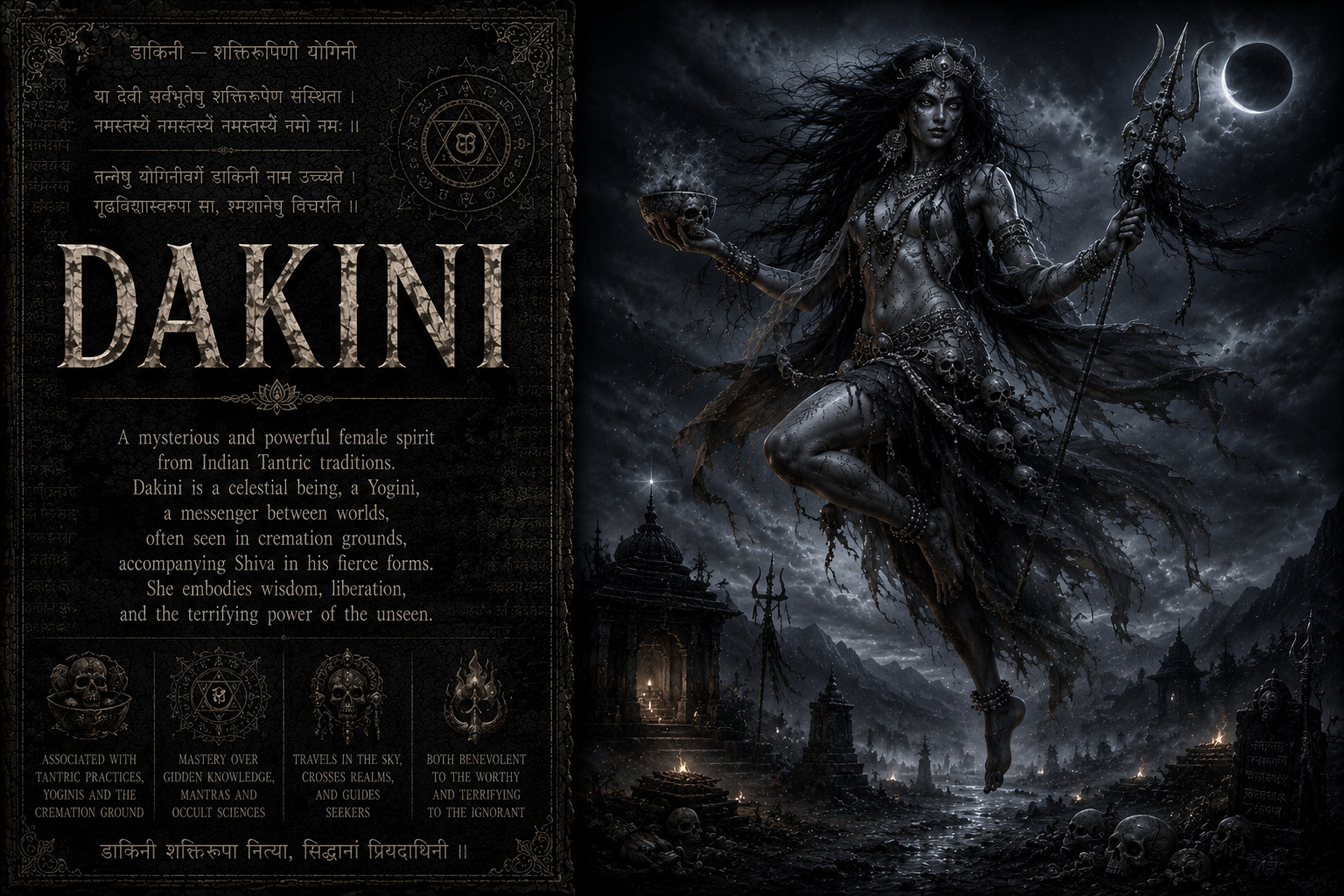
The Dakini occupies an incredibly complex and highly dangerous position within both mainstream Indian folklore and the deep, secretive layers of Tantric traditions. Unlike wandering human ghosts, a Dakini is a non-human, supernatural being possessing immense elemental and metaphysical power. In folk traditions, they are often feared as malevolent witches or demonic entities that feed on human flesh and children. However, in advanced esoteric study, Dakinis are understood as the fierce, unyielding guardians of secret knowledge, space, and elemental energy currents.
The mechanism of a Dakini encounter is entirely dependent on the spiritual purity and intent of the observer. To a foolish enthusiast, an unprotected occult practitioner, or a malicious person attempting to breach a sacred site, a Dakini manifests with terrifying, destructive fury. They manipulate the elements, causing localized environmental collapses, sudden violent storms, and an immediate degradation of the human nervous system. They can siphon a person's life force from a distance, inducing sudden, irreversible organ failure or severe internal hemorrhaging.
In private case files managed by veterans like Tantrik Ram Ashok, Dakini energies are often found guarding ancient, hidden seats of power (Shakti Peethas) or deep cremation grounds where advanced rituals are executed. They operate on strict cosmic rules of territorial and spiritual containment. Neutralizing or surviving a wrathful Dakini manifestation cannot be achieved through standard exorcisms or banishment traps; it requires an investigator to display total moral clarity, flawless ritual execution, and the proper esoteric permissions to show that they respect the profound, terrifying laws of cosmic evolution.
10. Shakchunni (The Domestic Matrix of Bengali Lore)
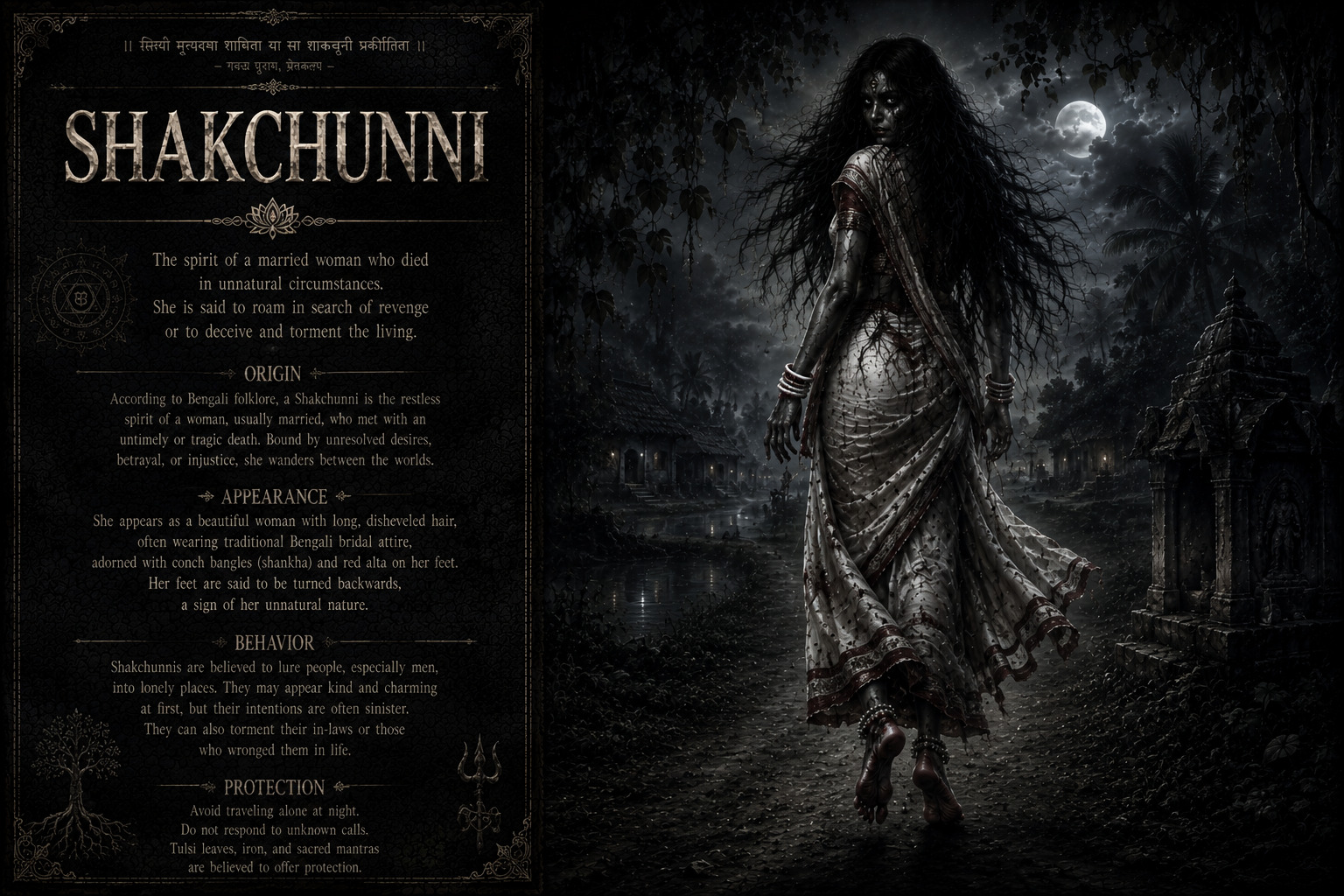
The Shakchunni is a prominent and terrifying female spirit deeply woven into the cultural folklore and domestic hauntings of Bengal. The name itself is a linguistic derivation of Sankhachurni, referring to Sankha — the white conch-shell bangles traditionally worn by married Hindu women in Bengal. A Shakchunni is born when a married woman dies prematurely with massive, unfulfilled desires for domestic life, maternal completion, or when her life is cut short by hidden domestic violence and sorrow.
The mechanism of a Shakchunni's manifestation is intimately tied to the symbols of marital identity. She almost exclusively haunts massive, damp trees common to the Bengal landscape, such as Mango or Tamarind trees near village ponds (Pukur). Ethereally, she remains intensely fixated on the material world she was forced to leave behind. She is known to actively hunt for young, newly married women who frequent these rural water bodies alone at dusk or noon. The Shakchunni seeks to possess these women, stepping directly into their bodies to live out her unfulfilled domestic desires.
When a Shakchunni takes over a host, the signs are distinct yet subtly hidden within domestic routines. The possessed woman will suddenly display a profound fondness for fish, consuming vast quantities of it raw or half-cooked in pitch darkness. She may be seen operating heavy household machinery with unnatural ease or gliding across floors without her feet making distinct contact. Most chillingly, family members report hearing the distant, rhythmic clicking of conch-shell bangles emanating from empty rooms. Purging a Shakchunni requires targeted Tantric purification rites that utilize specific herbs and sacred smoke to break her grip on the domestic matrix and forcefully release the host.
11. Masaan (The Ash-Born Predators of the Cremation Ground)
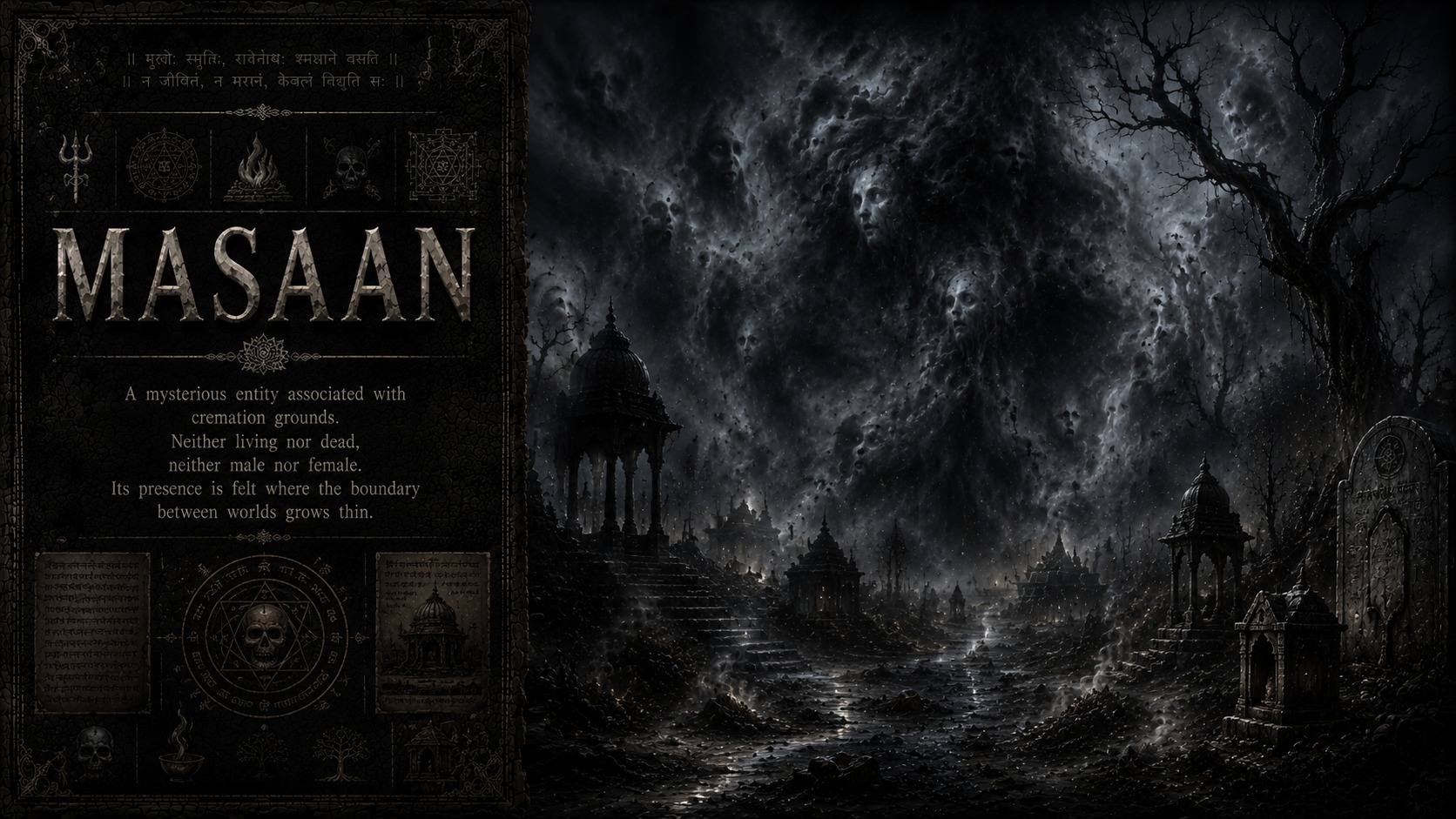
The Masaan is an exceptionally dark, primitive, and hostile entity found deep within the paranormal landscapes of Northern and Western India. Unlike ghosts born of emotional trauma, a Masaan is a spirit explicitly created, bound, and manipulated through the darkest channels of malicious black magic (Abhichara). They are engineered by rogue sorcerers who utilize the freshly burnt ashes, bones, and residual life forces of young children or infants cremated in Shamshans (cremation grounds).
The operational mechanism of a Masaan is purely destructive and serves as an energetic weapon. Once a sorcerer binds a Masaan to a specific target, the entity tracks the victim via their physical scent, footprint, or a personal item (such as hair or clothing) used in the initial ritual grid. The entity manifests as a dark, soot-like cloud or a gaunt, skeletal shadow that hovers around the victim's home. It emits a suffocating, dense aura that slowly chokes out the health, prosperity, and mental equilibrium of everyone residing within the target structure.
A victim under a Masaan attack experiences rapid, unexplainable physical wasting. They lose weight dramatically, their skin turns an ash-grey color, and medical diagnostics consistently fail to identify any underlying biological pathology. In his extensive career, Ram Ashok Kumar has documented that a Masaan curse is one of the most high-risk scenarios an investigator can encounter. Modern hardware yields zero metrics; instead, the investigator must deploy deep Tantric defense shields, using protective iron barriers and precise sacrificial counter-rituals to safely intercept the ash-born predator and break the sorcerer's unholy command.
12. Kichkandi (The Terrifying Shadows of the Eastern Valleys)
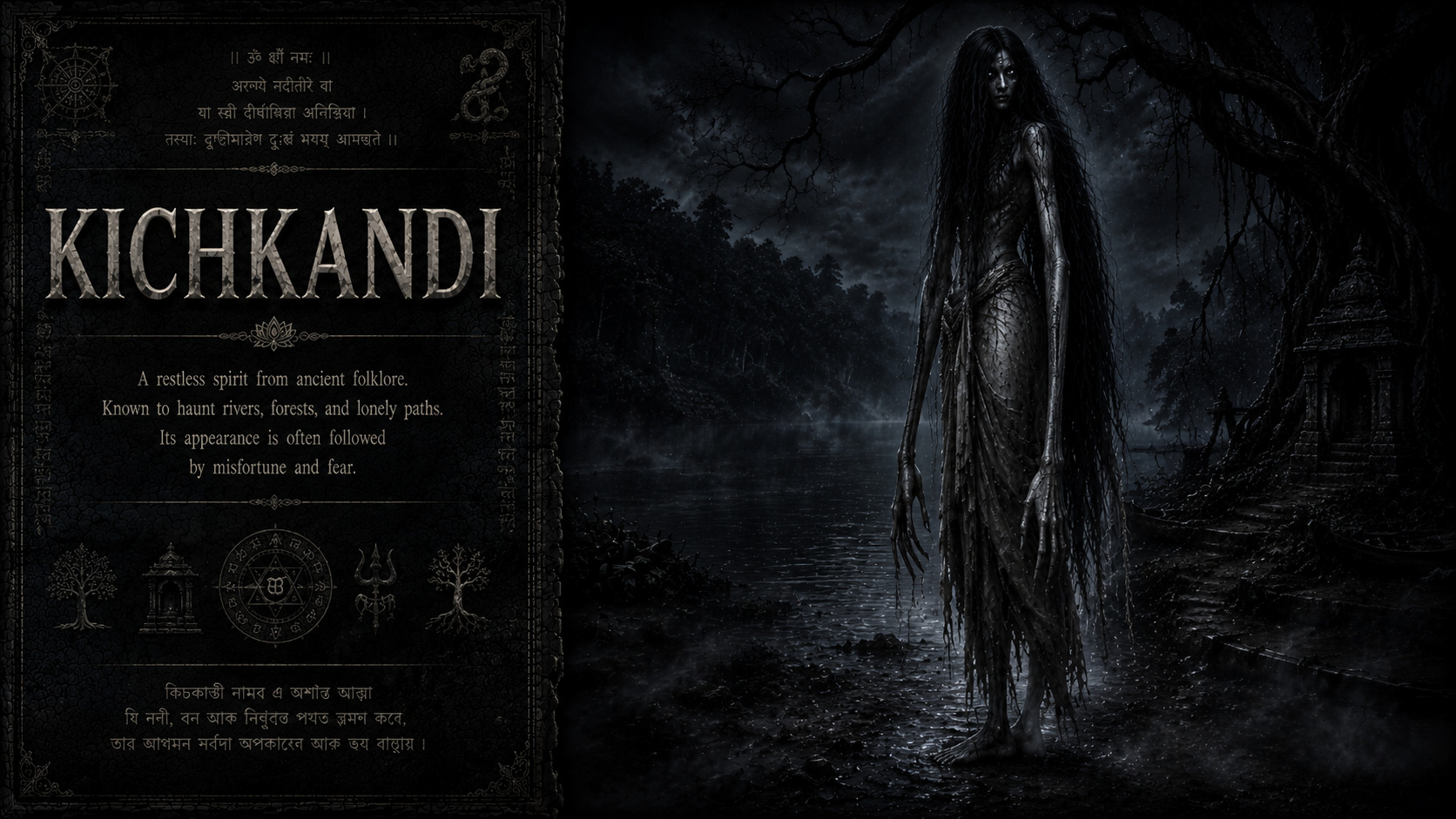
The Kichkandi is a formidable and deeply feared female supernatural figure native to the dense forests, rocky valleys, and rural settlements of Eastern India and the neighboring regions of Nepal. Born from a violent, sudden death — frequently involving young women who were brutally murdered or abandoned in isolated wilderness zones — the Kichkandi is an earthbound spirit consumed by a singular, unyielding fixation: raw, unadulterated vengeance against the living world.
The underlying mechanism of a Kichkandi's manifestation is characterized by severe spatial and environmental manipulation. She is traditionally described as possessing a gaunt, skeletal frame with unnaturally long, dark hair, but her defining physical marker is her lack of a human shadow and her backward-pointing feet. She operates predominantly during the late hours of the night, projecting an intense localized field of acoustic dread. Travelers entering her territory report hearing the sudden, piercing sound of a woman crying hysterically in the middle of a dense forest, which can instantly shift into a chilling, echoing laughter that disorients the listener's sense of direction.
Unlike benign spirits that loop passively through their trauma, the Kichkandi is highly aggressive and physically confrontational. She uses her terrifying appearance and sudden vocal distortions to cause her victims to freeze in absolute panic, inducing immediate psychological collapse or fatal cardiac events. For teams like Indian Paranormal Society, investigating a suspected Kichkandi zone requires heavy environmental profiling, using protective elemental grids and grounding mantras to contain the localized energetic fury and prevent the entity from tailing the team back across urban borders.
13. Odiyan (The Shape-Shifting Shadow Matrix of Kerala)
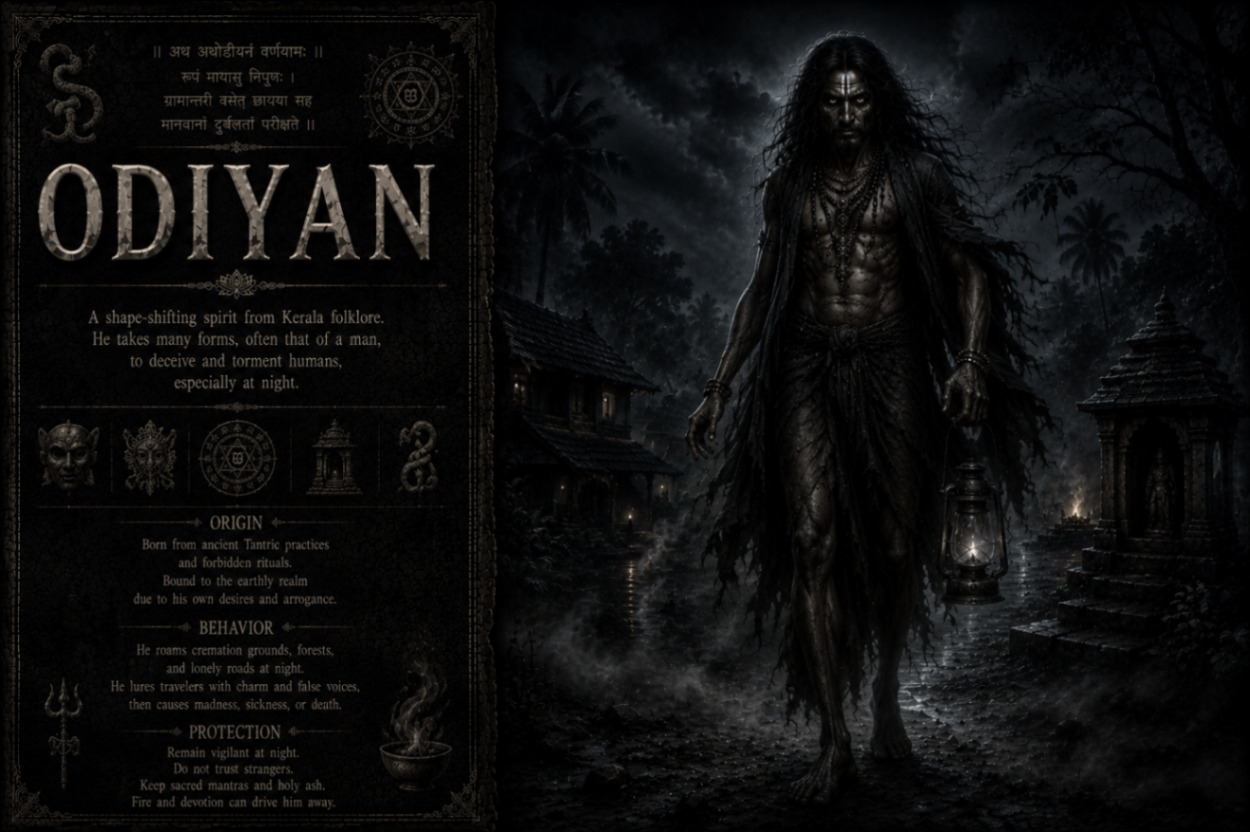
The Odiyan represents one of the most terrifying, clandestine, and lethal traditions of occult warfare found in the folklore of Kerala and Southern India. Unlike the independent spirits of the dead, an Odiyan was historically a living human practitioner — a sorcerer belonging to a secretive, outcaste clan who mastered the dark art of Odi Vidya. Through extreme, taboo rituals involving the extraction of embryonic fluids from pregnant women in pitch darkness, these practitioners gained the supernatural capability to manipulate matter, dissolve their physical form, and shape-shift into various animal shapes.
The operational mechanism of an Odiyan attack is built entirely upon ambush, sensory deception, and the total distortion of the natural environment. An Odiyan does not transform into a normal animal; instead, they manifest as malformed, unnaturally large creatures — such as a black bull with human eyes, a giant cat that casts no shadow, or a wild boar that moves in absolute silence. They position themselves along lonely village paths at night, waiting for a specific target to pass by.
When the victim approaches, the Odiyan uses a specialized hypnotic gaze and a localized pulse of overwhelming dread to paralyze the target's vocal cords and nervous system. They then execute a swift, lethal strike, snapping the victim's neck or crushing their chest, leaving behind a physical scene that looks like a tragic animal attack or a sudden freak accident. In modern anomalous study, the legacy of the Odiyan leaves behind a heavy, static shadow matrix in the rural undergrowth of Kerala. Tracking these residual fields requires deep ethnographic mapping and an understanding of ancient regional binding techniques to ground the lingering occult currents.
14. Naale Baa (The Urban Legend Grid of the Night)
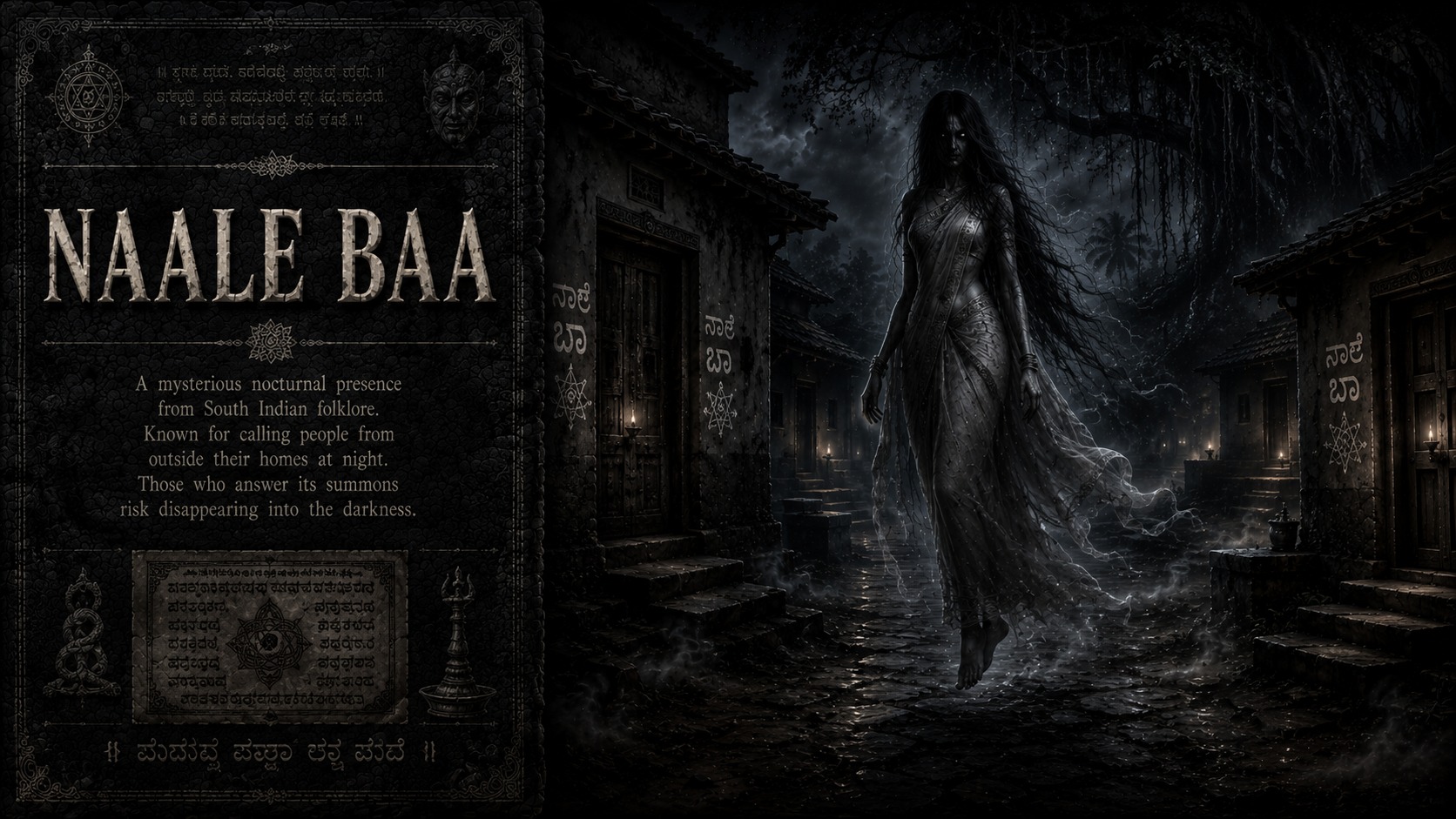
The legend of Naale Baa (which literally translates to 'Come Tomorrow' in Kannada) is one of the most fascinating and terrifying examples of an urban supernatural mechanism that gripped the city of Bengaluru and parts of Southern India during the 1990s. Unlike ancient forest spirits, Naale Baa represents a highly smart, adaptive entity that operationalizes its predatory lifecycle across dense, modern human architectural grids, targeting residential neighborhoods with systemic, mathematical precision.
The mechanism of the Naale Baa anomaly manifests as a mysterious, unseen entity — often associated with a bridal Churel or a malevolent witch — that knocks on the doors of houses at the dead of night. Like the Nishi of Bengal, the entity speaks in the exact voice of a close relative or mother, pleading for the door to be opened. If an unsuspecting resident opens the door, it results in an immediate, fatal curse, causing the individual to vomit blood and die before sunrise.
To counteract this deadly mechanical loop, communities discovered a unique semantic defense mechanism. Residents began writing the words 'Naale Baa' (Come Tomorrow) using charcoal or vermilion powder directly onto the front doors of their homes. When the entity arrived and read the inscription, the rules of its metaphysical architecture forced it to turn away and return the following night, creating a permanent, repeating loop that kept the household safe. In the archives of Indian Paranormal Society, Naale Baa is studied as a profound example of how folklore, architecture, and collective psychological defense can intersect to successfully manipulate and stall a high-risk supernatural entity.
15. Yakshini (The Alluring Parasites of Esoteric Desires)
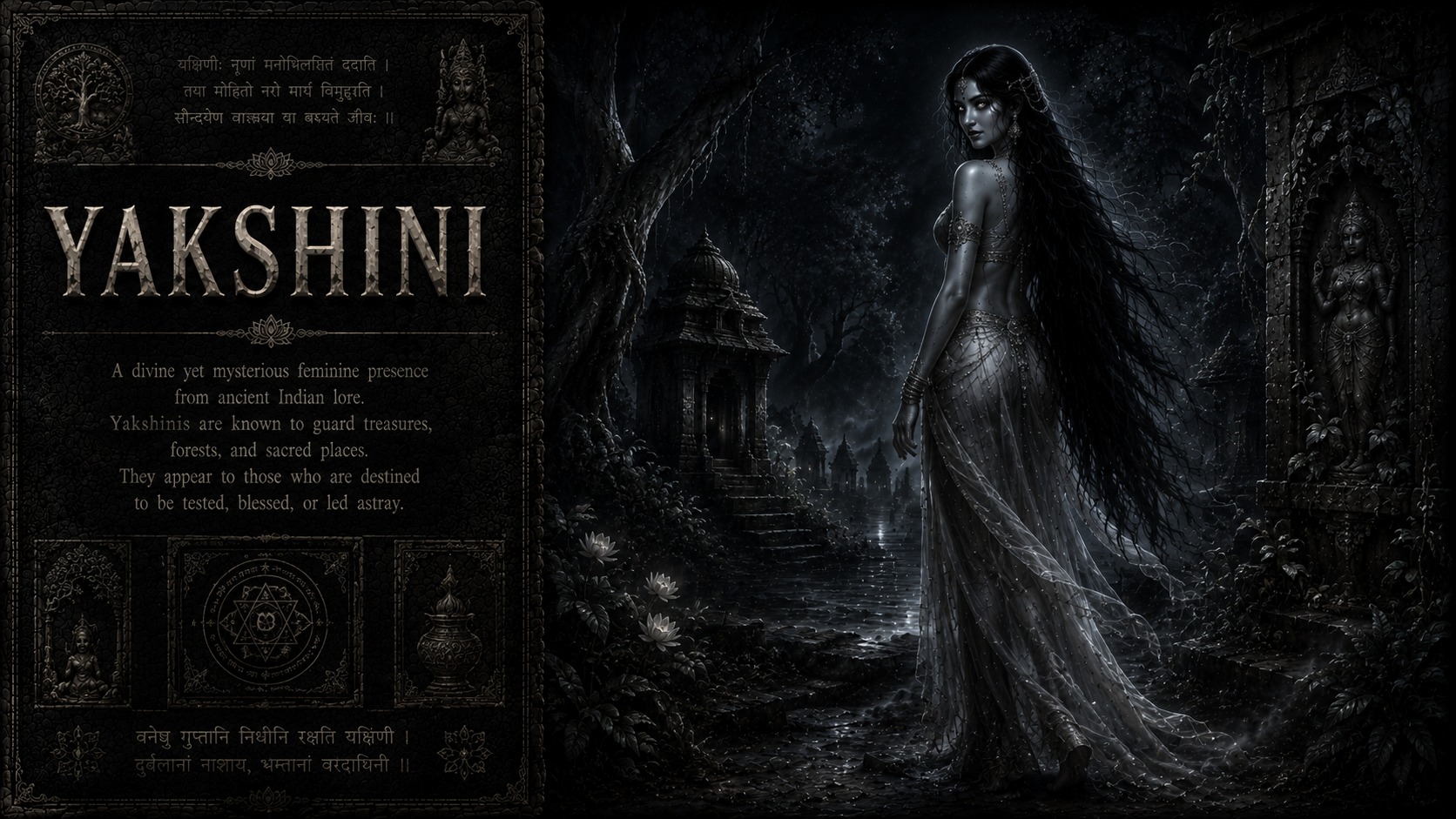
The Yakshini is a highly potent class of non-human nature spirits occupying a deeply volatile and dangerous position within ancient Indian folklore and the esoteric pathways of Tantra. Bound to the vibrant fertility, wealth, and raw creative life forces of the earth, Yakshinis are traditionally depicted as women of mesmerizing, supernatural beauty. While certain orders of Yakshinis can be benevolent guardians, folk traditions and private case logs warn heavily against a specific class of dangerous seductresses who look to trap and destroy human mortals.
The mechanism of a dangerous Yakshini interaction operates on intense psychological and relational hooks. In dark occult circles, an unprotected or greedy practitioner may attempt Yakshini Sadhana to invoke one of these entities, seeking absolute wealth, physical longevity, or supernatural companionship. The Yakshini manifests by testing the absolute limits of the human nervous system. She demands flawless ritual fidelity, complete secrecy, and total emotional surrender, often appearing as an alluring consort.
However, the trap is absolute. If the practitioner displays even a flicker of fear, greed, or breaks their sacred vows, the Yakshini's beautiful glamour instantly shatters into a terrifying, predatory aspect. She behaves as an energetic parasite, rapidly siphoning the practitioner's vital fluids, mental sanity, and Prana. Within a single cycle of the moon, the victim is left either permanently insane or as a completely withered, dried-out corpse. Ram Ashok Kumar's files treat Yakshini anomalies with extreme caution, as they demonstrate the absolute hazard of crossing human desire with unyielding, non-human elemental forces.
16. Jakhin (The Restless Shadows of the Western Ghats)
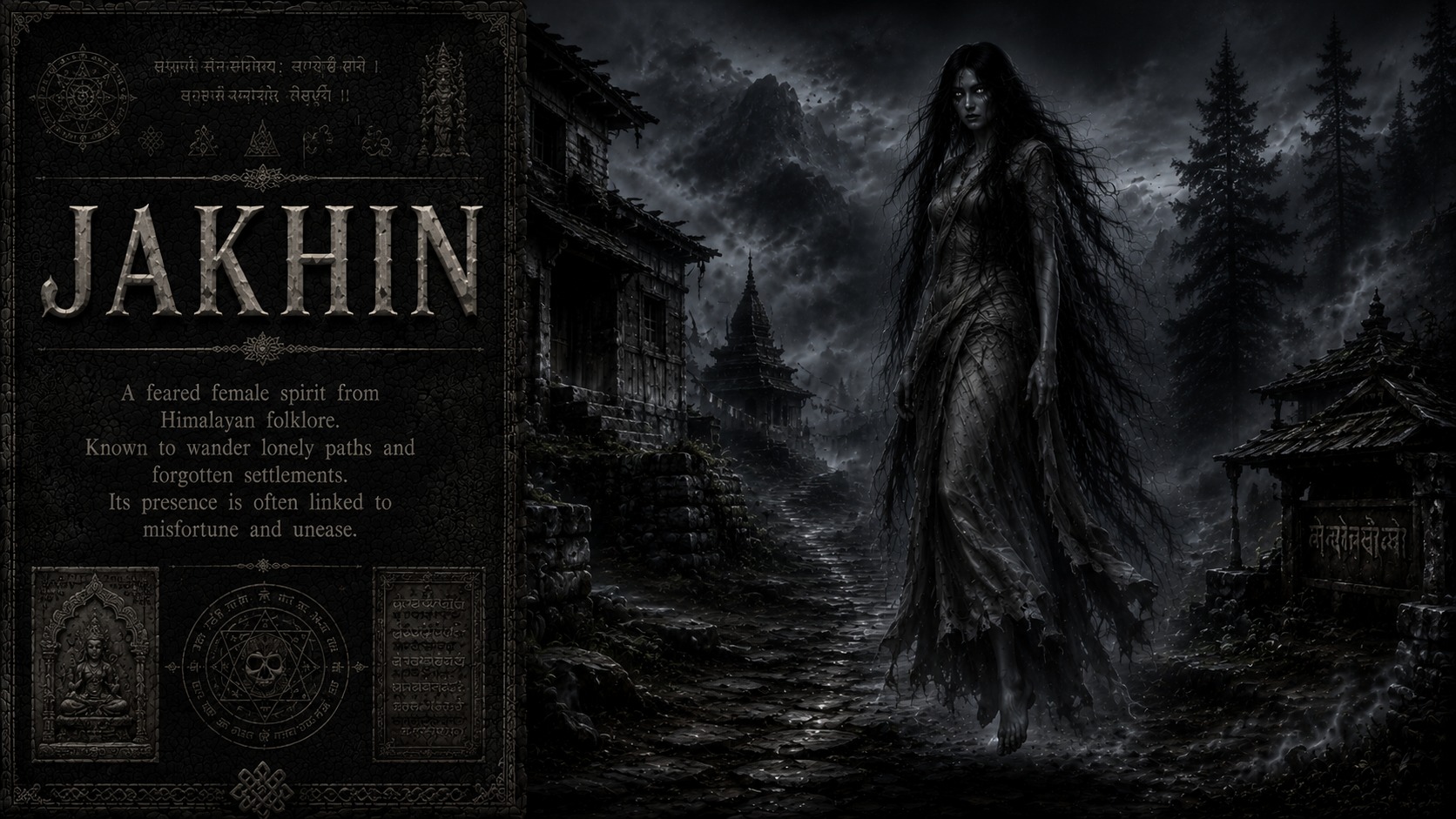
The Jakhin (or Jakhaeen) is a distinct and deeply feared female spirit heavily documented within the folklore, coastal villages, and mountain passes of Maharashtra, Konkan, and the Western Ghats. Rooted in regional folk beliefs, a Jakhin is the earthbound spirit of a married woman who passed away while her children were still young, or who died with an intense, unfulfilled obsession for her jewelry, household pride, and material possessions.
The mechanism of a Jakhin haunting is characterized by territorial possessiveness and extreme hostility toward domestic intruders. She typically haunts old ancestral family homes (Wadas), deep village wells, or hidden forest pathways leading to water bodies. Unlike chaotic entities that cause random physical violence, a Jakhin operates with a cold, focused intent: she seeks to protect what she believes still belongs to her. If a new family moves into her ancestral space or handles her lingering material belongings without performing proper pacification rituals, the Jakhin activates a localized field of intense domestic friction.
The household quickly descends into chaos — residents experience terrifying nightmares of a weeping woman drenched in water, cookware is violently thrown across empty kitchens, and the distinct, suffocating scent of stale turmeric and old cotton fills the air. In field investigations led by veterans like Tantrik Ram Ashok, resolving a Jakhin anomaly requires deep empathy combined with strict boundary containment. The investigator must perform specialized regional rites to honor her maternal status while utilizing specific binding mantras to safely ground her earthbound obsession and liberate the living space from her oppressive shadow.
17. Karn Pishachini (The Whispering Oracle of Occult Ruin)
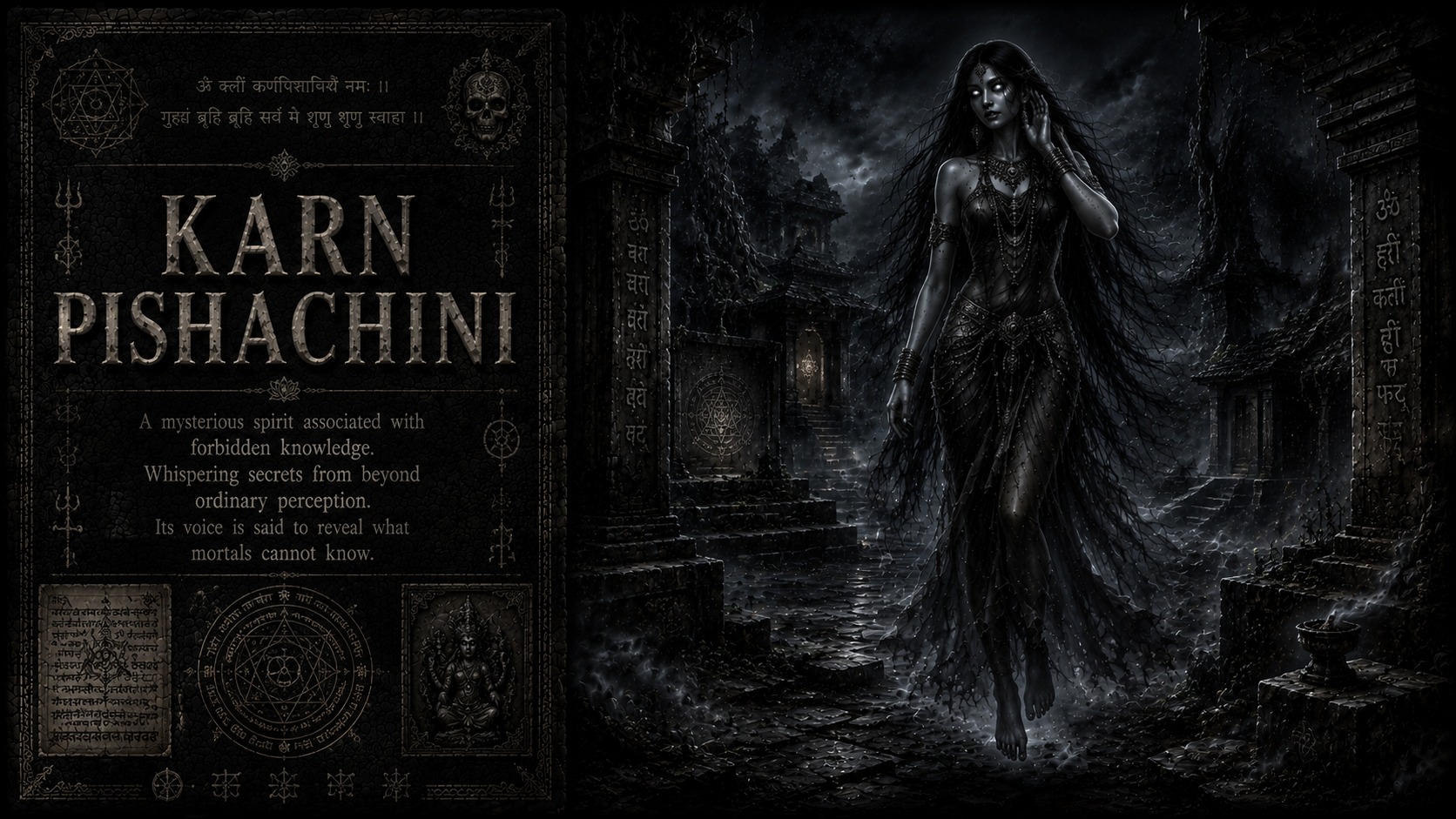
The Karn Pishachini stands as one of the most shadowy, forbidden, and destructive entities encountered within the deepest dark circles of Tantric and occult practices. Unlike standard spirits that happen to haunt a specific physical location, the Karn Pishachini is a specialized, low-tier demonic entity explicitly invoked by a practitioner through highly taboo, dangerous rituals involving filth, blood, and the deliberate degradation of spiritual purity.
The underlying mechanism of a Karn Pishachini is her role as an auditory psychic oracle. Once successfully bound to a practitioner, she resides permanently within their energetic aura, specifically targeting the auditory cortex of the left ear (hence Karn, meaning ear). She possesses the supernatural capability to scan the immediate timeline, allowing her to whisper the exact past, hidden secrets, and immediate present circumstances of any individual who walks into the room with the practitioner. This grants the occultist an illusion of absolute divine clairvoyance, allowing them to easily manipulate clients and amass wealth.
However, the karmic price of this contract is absolute ruin. The Karn Pishachini is an incredibly jealous, volatile, and demanding entity. She feeds aggressively on the practitioner's vital energy, peace of mind, and moral sanity. Over time, her constant, unceasing whispering in the ear shifts from secret data into terrifying screams, graphic insults, and demands for blood, driving the practitioner into a state of agonizing, permanent insomnia. Ram Ashok Kumar emphasizes that breaking a Karn Pishachini bond is one of the most hazardous tasks in paranormal science, as the entity will violently attack both the practitioner and the investigator to protect her parasitic hold over the victim's soul.
18. Pret (The Glitched Transition of Torment)
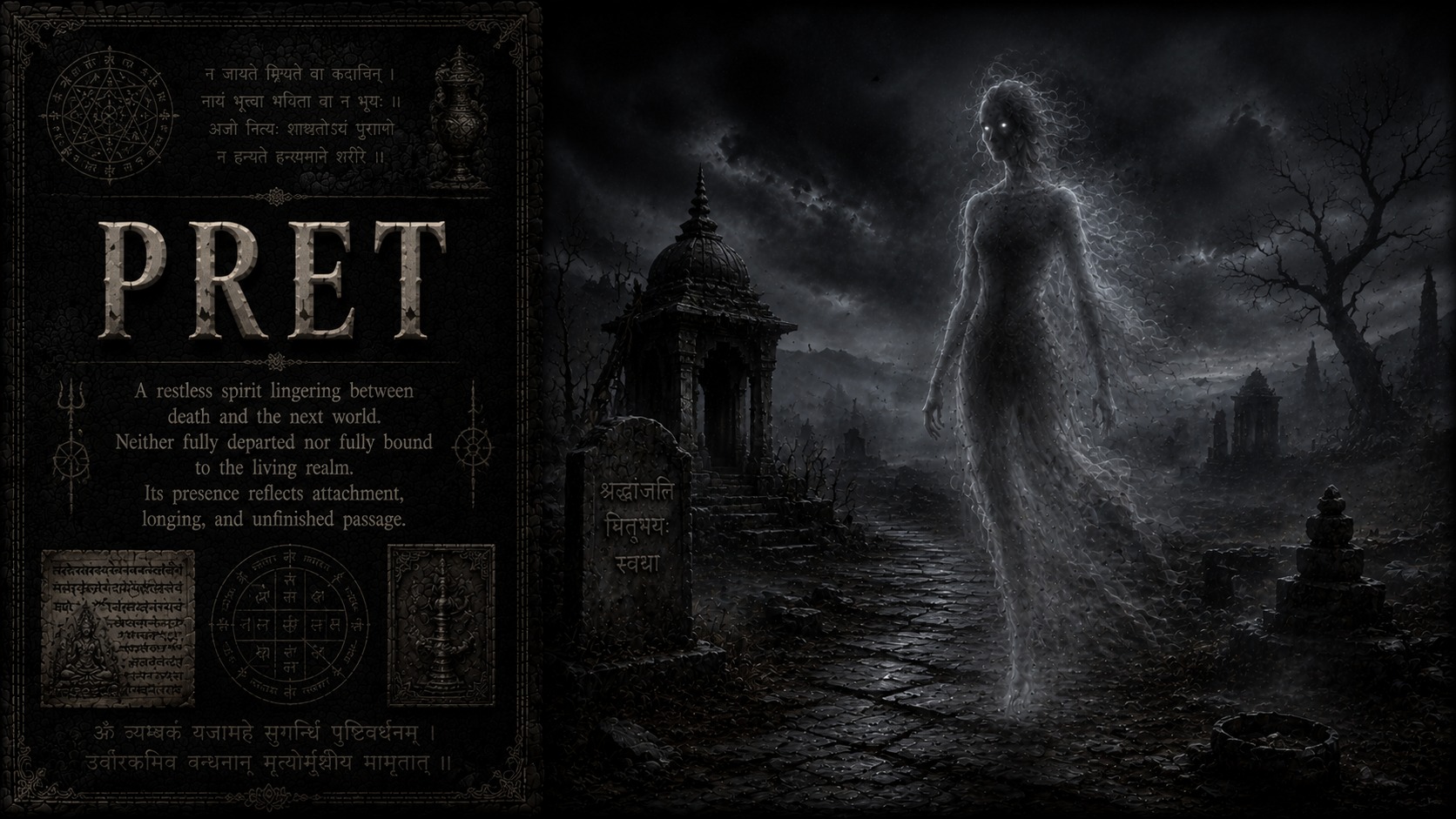
The Pret (or Preta) serves as a foundational archetype within the anomalous research framework of Indian Paranormal Society, representing a tragic, highly volatile metaphysical state. Far from a standard ghost story, a Pret — often translated as a hungry ghost — is the direct consequence of a completely glitched, failed spiritual transition. When an individual passes away with intense, unfulfilled earthly attachments, or when their living descendants fail to execute the sacred funeral and Pinda Daan rituals during Pitru Paksha, the subtle mind-body (Lingasharira) fails to release from our physical spectrum.
The consciousness undergoes a violent, agonizing degradation, warping into an ethereal form characterized in ancient texts as having a bloated, massive stomach and a needle-thin throat. The operational mechanism of a Pret is defined by an energetic paradox: they suffer from an infinite, raging thirst and hunger, yet their physical pathways are too narrow to ingest any nourishment. If they attempt to touch food or clean water, the matter instantly transforms into liquid fire, ash, or foul, boiling gases due to their dense, negative karmic field.
Prets do not typically possess living hosts to control them directly; instead, they project an oppressive aura of total psychological and environmental decay. They congregate in liminal, unholy spaces — such as crossroads, barren lands, and the outer rims of cremation grounds. A living person entering their localized grid will experience a sudden, unnatural dryness in the throat, an unprovoked drop in environmental temperature, and a wave of deep, suicidal despair. Resolving a Pret anomaly requires moving away from electronic gadgets and deploying precise Vedic and Tantric interventions to force open the blocked transition channels, allowing the trapped consciousness to finally exhaust its karmic anchor and progress safely into the afterlife.